Midwest summers don’t just bring heat to the Chicagoland area – they bring suffocating humidity. During a heatwave, there’s nothing worse than walking into your home, hearing the air conditioner blasting at full throttle, and still feeling like you’re stepping into a swamp. Your thermostat says it’s 70 degrees, but your skin feels sticky, the air feels heavy, and the sheets on your bed feel strangely damp.
When this happens, most people’s first reaction is to assume the AC unit is broken or undersized. But if cold air is coming out of the vents, your cooling system might actually be doing its job. The real problem often isn’t how much cold air your HVAC unit produces- it’s how easily humid outdoor air is sneaking into your home.
The “Cracked Cooler” Effect
Think of your home like a portable cooler on a hot summer day. If you pack it with ice, close the lid tightly, and leave it in the sun, everything inside stays dry and freezing cold. But if the seal along the lid is cracked or worn out, warm air leaks in, ice melts, and the inside turns into a damp mess.
Your air conditioner functions best in a sealed environment. As it cools your home, it pulls moisture out of the indoor air and drains it outside. However, if humid Chicagoland air is constantly leaking through your home’s exterior, your AC gets trapped in a losing battle. Moisture enters the house faster than the system can remove it, leaving you with cold, clammy rooms and a skyrocketing power bill.
Where Humidity Is Actually Sneaking In
Most homeowners don’t realize how much air passes right through the exterior barrier of their house. During peak humidity, moisture finds the path of least resistance:
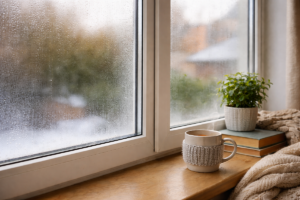
- Failing Window Seals: Older single-pane or double-pane windows lose their airtight seals over time. Even if you can’t see visible condensation between the glass, microscopic gaps around the frame allow heavy, humid air to continuously migrate indoors.
- Worn Entry and Patio Doors: Weatherstripping degrades after a few Chicagoland winters. If you can see light around the edges of your front door or sliding patio door, humid air is flowing freely into your living space.
- Uninsulated Exterior Siding: Standard siding without an adequate weather-resistive barrier or insulation backing allows heat and moisture to build up against your exterior walls, slowly radiating dampness directly into your drywall.
Simple Fixes vs. Real Solutions
Before making any big decisions, start with a few basic checks. Ensure your thermostat fan is set to “AUTO” rather than “ON.” When the fan runs continuously on “ON,” it blows air across wet AC coils, pushing moisture back into your living space after the cooling cycle stops. Also, check your air filter, a clogged filter restricts airflow and hurts your system’s ability to dehumidify.
However, if your HVAC settings are correct and the house still feels like a sauna, the issue is almost certainly an exterior home barrier like home windows, doors, siding, or roofing. You can crank the thermostat down to 65 degrees, but lowering the temperature won’t fix drafty frames or deteriorating seals- it will only freeze your utility budget.
Lock Out the Humidity with Olson Windows
To achieve true, crisp indoor comfort during a Midwest heatwave, your home needs a tight exterior defense. Premium, energy-efficient window replacements, properly weather-sealed doors, and modern insulated siding act as a protective barrier, stopping heavy humidity at your property line so your AC can finally do its job efficiently.
If you’re tired of living in a clammy home every summer, let the local experts at Olson Windows, Doors, Siding & Roofing take a look. We’ve been helping Chicagoland homeowners improve their home’s energy efficiency and indoor comfort for decades.
Contact Us Today!
If the heatwave has left you questioning the integrity of your home’s exterior, don’t wait! Contact us today or stop by our Barrington showroom to get started. Olson Windows does not offer repair or handyman services, we are strictly an installation and replacement contractor!